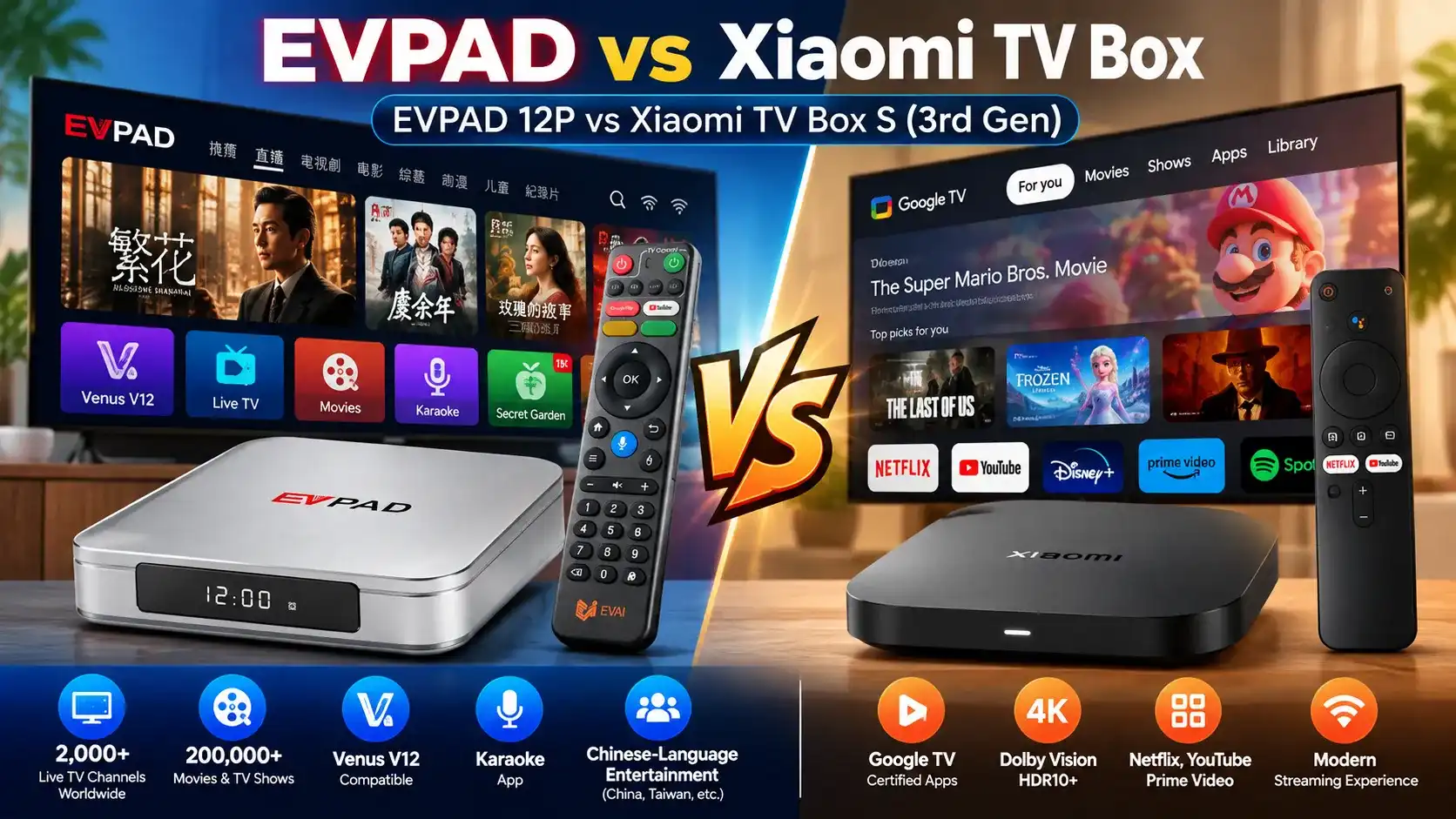
Comparing EVPAD vs Xiaomi TV Box in Malaysia? The EVPAD 12P Malaysia Version and Xiaomi TV Box S (3rd Gen) both offer 4K entertainment, but they cater to different viewing preferences.
Xiaomi focuses on Google TV and mainstream streaming services. EVPAD stands out for Chinese-language entertainment, its Venus V12 app ecosystem and additional features such as karaoke. Here is how to choose between them.
Quick Verdict
Choose EVPAD 12P if you are an overseas Chinese viewer looking for Chinese-language entertainment, Venus V12 features, karaoke and more storage and connectivity options.
Choose Xiaomi TV Box S if you prioritize Netflix, YouTube, Google TV and premium picture formats such as Dolby Vision.
EVPAD 12P vs Xiaomi TV Box S: Quick Comparison
| Feature | EVPAD 12P | Xiaomi S 3rd Gen |
|---|---|---|
| Best For | Chinese-language entertainment and EVPAD features | Mainstream streaming and Google TV |
| RAM / Storage | 4GB / 64GB | 2GB / 32GB |
| Processor | Cortex-A53 | Cortex-A55 |
| System | Android 12 | Google TV |
| Apps | Venus V12 and compatible Android apps | Google TV apps and certified streaming services |
| Video | 4K, HDR10 | 4K, Dolby Vision, HDR10+ |
| Ethernet | Built-in LAN port | No built-in LAN port |
| Remote | Voice and air mouse | Bluetooth voice remote |
For other brands and buying considerations, see our TV Box Malaysia guide.
Hardware and Performance: RAM, Storage and Processor
EVPAD 12P offers 4GB RAM and 64GB storage, twice the advertised capacity of Xiaomi TV Box S (3rd Gen). This gives users more space for compatible applications, downloaded files and app data.
Xiaomi uses a newer Cortex-A55 processor architecture, while EVPAD uses Cortex-A53. Actual speed depends on software optimization and workload, so the specifications alone do not establish an overall performance winner.
Verdict: EVPAD has the advantage in RAM and storage. Xiaomi offers a newer processor architecture and a system built around Google TV.
Software and Streaming App Compatibility
This is where the biggest difference between EVPAD and Xiaomi becomes clear.
EVPAD: Chinese-Language Entertainment and Venus V12
EVPAD is particularly appealing to overseas Chinese households that want easier access to Chinese-language entertainment. Its entertainment ecosystem is promoted for viewing options associated with mainland China, Taiwan and other Chinese-speaking markets.
EVPAD also promotes a large entertainment library, with marketing figures of 2,000+ live HD TV channels and 200,000+ movies and TV shows. These are advertised figures rather than independently verified counts. Actual availability, picture quality and access rights can vary by app, location and time.
One of EVPAD 12’s key features is compatibility with the Venus V12 app ecosystem. For installation instructions, see our guide to installing Venus V12 on EVPAD 12.
This makes EVPAD worth considering for viewers who prioritize Chinese-language programming and want to explore its dedicated entertainment applications.
Xiaomi: Google TV and Mainstream Streaming
Xiaomi TV Box S (3rd Gen) runs Google TV and is designed for popular services such as Netflix, YouTube and Prime Video. Its certified streaming environment is an advantage for users who want familiar apps and supported playback features.
EVPAD’s Android-based system does not automatically provide the same streaming certifications. For example, 4K video output does not guarantee Netflix 4K playback.
Verdict: EVPAD is more closely tailored to viewers seeking its Chinese-language entertainment ecosystem. Xiaomi is better suited to mainstream subscription streaming and Google TV users.
Video Quality and Connectivity: What Are the Differences?
4K, HDR and Audio
Both devices support 4K video output. Xiaomi adds Dolby Vision and HDR10+, making it attractive for users with compatible televisions and content.
EVPAD 12P supports HDR10 and offers additional audio connection options. Picture quality depends on the source, display and supported playback format.
Wi-Fi, Ethernet and Ports
EVPAD 12P includes a built-in Ethernet port, along with HDMI, USB, SPDIF, AV and TF card connections. This is useful for buyers who prefer wired internet or want to connect compatible accessories.
Xiaomi offers a simpler setup with HDMI and USB, but no built-in Ethernet port.
Verdict: Xiaomi has the advantage in premium HDR formats, while EVPAD provides more physical connection options.
Remote Control and Everyday Experience
EVPAD 12P includes a voice remote with air mouse functionality, giving users a pointer-style option for navigating compatible apps.
Beyond regular video playback, EVPAD also promotes entertainment features such as karaoke and other dedicated applications.
For adult users, the EVPAD ecosystem also includes the Secret Garden app (18+). Availability and access depend on the applicable software and regional conditions. Learn more in our EVPAD Secret Garden app guide.
Xiaomi focuses on a streamlined Google TV interface, voice search, content recommendations and supported casting features.
Verdict: EVPAD offers a broader range of brand-specific entertainment features, while Xiaomi emphasizes straightforward navigation through established streaming apps.
Price, Warranty and Regional Compatibility in Malaysia
EVPADSG lists the EVPAD 12P Malaysia Version at a promotional price of US$165, subject to change. Xiaomi TV Box S (3rd Gen) prices vary across Malaysian retailers.
For ongoing costs, the key difference is how you plan to watch content. Some EVPAD-compatible apps may be free to download and use, potentially reducing spending for viewers whose preferred content is legitimately available at no charge.
However, free app installation does not guarantee free access to every channel, movie or program. Content availability and licensing conditions vary. Xiaomi also supports free applications, while services such as Netflix may require separate subscriptions.
EVPADSG advertises a one-year defect replacement policy and 30-day returns, subject to its terms. Buyers should also note that the EVPAD 12P Malaysia Version has regional restrictions and is not intended for use in North America or Europe.
Verdict: EVPAD may offer lower ongoing costs for certain viewing habits, but neither device should be treated as a guarantee of free access to paid content.
EVPAD or Xiaomi: Which Should You Buy?
The right choice depends less on which device has the highest specifications and more on the entertainment your household actually enjoys.
Choose Xiaomi TV Box S If…
- You mainly watch Netflix, YouTube and other mainstream streaming services.
- You prefer Google TV and its familiar app interface.
- You want Dolby Vision or HDR10+ for a compatible television.
- You do not need additional ports or a built-in Ethernet connection.
Choose EVPAD 12P If…
- You are an overseas Chinese viewer interested in entertainment from mainland China, Taiwan and other Chinese-speaking regions.
- You want access to the EVPAD Venus V12 app ecosystem, subject to supported availability.
- You enjoy extra entertainment features such as karaoke and dedicated EVPAD apps.
- You prefer 4GB RAM, 64GB storage and built-in Ethernet.
- You want to explore free-to-use entertainment options while checking content availability and licensing.
Our recommendation: Xiaomi is a practical choice for mainstream streaming. EVPAD 12P is especially appealing to Chinese-speaking households in Malaysia that value its dedicated entertainment ecosystem, additional features and flexible connectivity.
Explore EVPAD 12P Malaysia Version
Interested in Chinese-language entertainment, Venus V12 features, karaoke and more storage? Explore the EVPAD 12P Malaysia Version and check its supported apps, regional compatibility and warranty details.